On November 14, the 7th Energy Internet International Innovation Summit 2025 and the 2025 Conference on Renewable Energy Power Technology Innovation and Industrial Development were held in Chengdu. The event was guided by Tsinghua University and the China–EU Energy Technology Innovation Cooperation Office, hosted by the Administrative Committee of Sichuan Tianfu New Area, the Domestic Cooperation Office of Tsinghua University, and the International Innovation Center for Energy Internet, and organized by the Renewable Energy Power Professional Committee of the Chinese Renewable Energy Society, the Tsinghua Sichuan Energy Internet Research Institute, and the Sichuan Electric Power Industry Association.

Figure 1: Summit Venue
With the theme of “Integrated Development of Scientific and Technological Innovation and Industrial Innovation,” the conference brought together more than 430 representatives from government departments, universities, research institutions, leading enterprises, and international organizations to jointly assess new trends in energy transition and explore new pathways for transforming scientific and technological achievements, providing intellectual support and cooperative momentum for the construction of a new energy system under the “dual-carbon” goals. Nearly 10,000 participants also attended the conference via online live streaming. The opening ceremony and keynote report sessions were respectively chaired by Kang Chongqing, Head of the Department of Electrical Engineering of Tsinghua University and President of the Tsinghua Sichuan Energy Internet Research Institute, and Lu Zongxiang, Executive Vice President of the Tsinghua Sichuan Energy Internet Research Institute.
I. Coordinated Integration to Build a New Development Paradigm
Zheng Li, Vice Chair of the University Council of Tsinghua University; Zeng Guang, Deputy Director of the Sichuan Provincial Energy Bureau; and Liu Di, Chair of the Renewable Energy Power Professional Committee of the Chinese Renewable Energy Society, delivered opening remarks. All three speakers emphasized the need to thoroughly implement national energy strategy deployments, follow the trend of green and low-carbon transformation, strengthen the coordinated advancement of scientific and technological innovation and industrial innovation, and promote high-quality development of national and local energy sectors.

Figure 2: Guest Speeches (from left to right: Zheng Li, Zeng Guang, Liu Di)
At the meeting, the Tsinghua Sichuan Energy Internet Research Institute signed cooperation agreements with multiple organizations. Cooperation agreements were signed with the Western Transformation Center for Advanced Technological Achievements and the Tianfu International Technology Transfer Center to build a high-level platform for the transformation of scientific and technological achievements; agreements were signed with the Xidian Research Institute and Chengdu Science and Technology Service Group Co., Ltd. to jointly advance the integrated development of “government–industry–academia–research–application” to a new stage; and agreements to jointly establish R&D centers were signed with Wheat New Energy (Beijing) Technology Co., Ltd., Nanjing Jiangxing Lianjia Intelligent Technology Co., Ltd., Shenzhen Zhonghe Energy Storage Technology Co., Ltd., and Shanghai Huagan Digital Technology Co., Ltd., opening a new chapter in collaborative innovation and technological breakthroughs.
II. Gaining Insight into the Frontier and Discussing the Energy Future
During the keynote report session, multiple experts and scholars, drawing on their latest research findings and practical experience, provided in-depth analyses of the latest progress in energy technology innovation and industrial integration, presenting an academic feast combining intellectual vision with professional depth.
Li Licheng, Academician of the Chinese Academy of Engineering and Honorary Chair of the Expert Committee of China Southern Power Grid, delivered an invited report titled Reflections on Power System Balance Theory under the Background of New Energy as the Mainstay. He pointed out that the development and practice of new energy have pushed power systems to a historical juncture requiring the reshaping of theoretical and technological systems. It is urgent to construct a balance theory for new-type power systems based on the first principles of real-time power and energy balance, with intelligent and transparent technological pathways providing solid support for this theoretical framework.
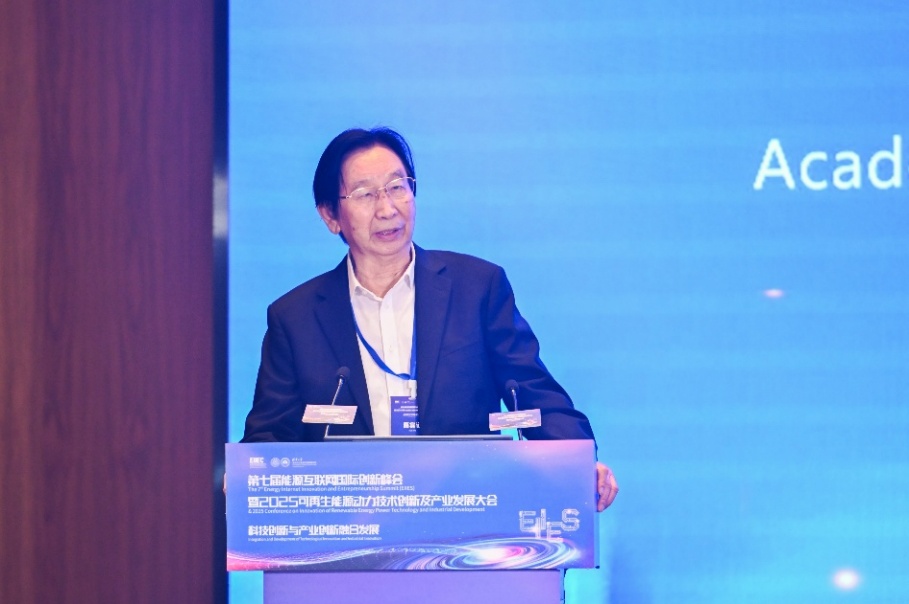
Figure 3: Invited Report by Li Licheng
Bi Yaxiong, Academician of the United Nations International Academy of Ecological Life Safety and Vice Chairman of the China Workers’ Technical Association; Fan Qixiang, former Deputy General Manager of China Huaneng Group Co., Ltd.; Wu Yun, former Member of the Party Committee and Deputy General Manager of China Energy Engineering Group Co., Ltd.; and Wang Xiongfei, Chief Scientist of the New-Type Power Systems and Key Equipment Research Center of the Tsinghua Sichuan Energy Internet Research Institute, respectively delivered themed presentations on Promoting Desert Governance through the Coupled Development of Solar Thermal Power and Hydrogen, Carbon Footprint Analysis and Digital Management of Hydropower Projects, Development of New Energy Storage Technologies and Industrial Upgrading, and Grid-Forming Energy Storage Technologies for New-Type Power Systems: Principles, Applications, and Development Trends, offering profound insights and valuable references to the participants.

Figure 4: Keynote Reports (from left to right, top to bottom: Bi Yaxiong, Fan Qixiang, Wu Yun, Wang Xiongfei)
III. Building Momentum into Chains and Opening a New Chapter for Industry
Guided by openness, cooperation, and cross-sector integration, the conference hosted a themed forum on “Innovative Development of the Renewable Energy Power Industry,” creating a high-level dialogue platform that brought together diverse stakeholders. Expert representatives from leading enterprises such as CRRC, Dongfang Electric, and Windey Energy, as well as universities and research institutes, engaged in exchanges and discussions on industrial chain coordination, core technology breakthroughs, and application scenario implementation, collectively showcasing the latest progress in China’s energy industry transformation and upgrading.
During the conference, the “EXCEL Accelerator Camp” innovation enterprise empowerment session was also held, focusing on the display of cutting-edge achievements and incubation of entrepreneurial projects. It provided a platform for startups to showcase and communicate, and through project roadshows, investment and financing dialogues, and resource linkages, further stimulated innovation vitality and cooperation potential in the energy sector.

Figure 5: Accelerator Camp Special Session


















 News & Events