On July 22, during the 2026 General Meeting of the Power and Energy Society (PES) of the Institute of Electrical and Electronics Engineers (IEEE), the "Symposium on Education, Teaching, and Career Development in Energy and Power in the Age of AI," supported by the Department of Electrical Engineering at Tsinghua University and organized by the North American Tsinghua DEE Alumni Association, was successfully held in Montreal, Canada. The symposium was convened in conjunction with a networking gathering of North American Tsinghua DEE Alumni and friends. Alumni of Tsinghua University from around the world, along with experts, scholars, and industry peers in the energy and power sector, came together to engage in in-depth discussions on education, teaching, research innovation, and career development in the field against the backdrop of the AI era.
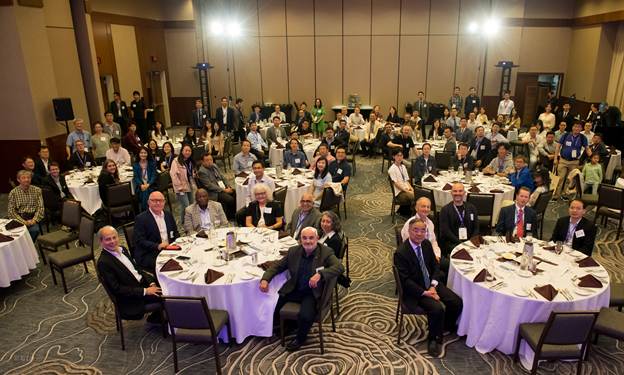
Group photo of symposium attendees
In addition to bringing together Tsinghua alumni from all corners of the globe, the symposium specially invited a number of distinguished international guests, including IEEE Past President Professor Saifur Rahman, IEEE PES Past President Academician Jessica J. Bian, IEEE PES President-Elect Academician Bikash Pal; U.S. National Academy of Engineering members Anjan Bose, Kaushik Rajashekara, Kevin Tomsovic, Yilu Liu, and Joe H. Chow; Canadian Academy of Engineering members Claudio Cañizares and Innocent Kamwa; Fellows of the U.K. Royal Academy of Engineering Jovica Milanovic and Tim Green; Tsinghua University Distinguished Visiting Professors Nikolaos Chatziargyriou, Vladimir Terzija, and Lang Tong; and editorial board members of journals such as iEnergy, CSEE JPES, and MPCE, including Kai Strunz, Pierluigi Mancarella, Xiaoping Zhang, Lei Wu, Jianguo Zhu, Jianhui Wang, and Xiaonan Lu. Furthermore, the event also invited leading domestic experts in the energy and power sector, including Professor Fu Yang, Vice President of Shanghai University of Electric Power; Professor Huang Ying, Vice Dean of the College of Electrical Engineering at Zhejiang University; Professor Gu Wei, Secretary of the Party Committee of the School of Electrical Engineering at Southeast University; Professor Dong Xuzhu of Wuhan University; Professor Zhu Jizhong of South China University of Technology; and Professor Luan Wenpeng of Tianjin University.
Participants at the symposium hailed from multiple countries and regions, including the United States, Canada, the United Kingdom, Germany, Switzerland, Finland, Australia, South Korea, Japan, and Hong Kong, China. Their affiliated institutions encompassed universities such as Harvard University, Princeton University, Cornell University, Columbia University, Purdue University, Washington State University, the University of Texas, UCLA, UC Riverside, the University of Oxford, the University of Cambridge, Imperial College London, Newcastle University, the University of Waterloo, Université Laval, the University of Melbourne, Yonsei University, Korea University, the Chinese University of Hong Kong, and the Hong Kong Polytechnic University, as well as power market operators including PJM Interconnection, California ISO, ISO New England, and ERCOT, and corporations such as Powertech Labs, RTDS, Google, Siemens, and Mitsubishi.
From Tsinghua University, Professor Kang Chongqing, Dean of the Department of Electrical Engineering, along with faculty members Wu Wenchuan, Ci Song, Zhong Haiwang, Guo Hongye, and Lin Chenhui, as well as Professor Geng Hua from the Department of Automation, attended the conference. Several young alumni, postdoctoral researchers, and doctoral students from Tsinghua also participated in the symposium. The symposium was moderated by Lyu Ruike, a 2026 doctoral alumnus of Tsinghua University, and Chen Jiaqi, a 2020 master's alumna. Throughout the symposium, real-time AI-powered bilingual subtitles in Chinese and English were provided, with speech content simultaneously displayed on the main screen, facilitating smooth participation and interaction for international guests.
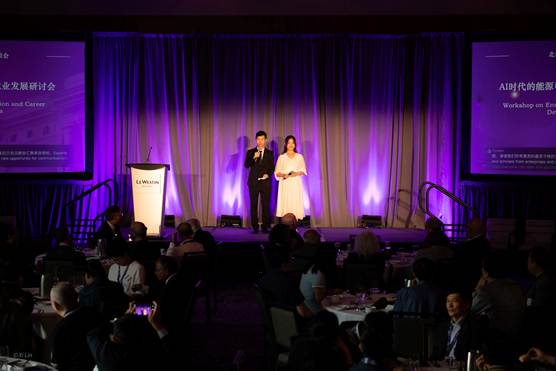
Lyu Ruike (left) and Chen Jiaqi (right) moderating the symposium
At the opening of the symposium, Professor Kang Chongqing delivered a welcome address, extending greetings to the guests, alumni, and friends. He noted that this event expanded the traditional alumni networking gathering into a professional forum open to international peers, with the aim of broadening the scope of exchange and deepening its substance. Addressing educational reform in the AI era, he emphasized that AI applications must remain firmly grounded in the fundamentals of electrical engineering and be subject to the scrutiny of physical laws, engineering constraints, and safety requirements. Talent development, he stressed, should not only equip students with the ability to use AI but also enable them to identify real-world problems, validate authentic outcomes, and tackle practical challenges. He also introduced the exploratory efforts of Tsinghua's Department of Electrical Engineering in AI-empowered teaching and the development of domain-specific knowledge engines.
Saifur Rahman, Jessica J. Bian, and Bikash Pal each delivered addresses, offering their best wishes to the symposium and sharing insights with the attendees from the perspectives of international academic organizations and the broader development of the electric power and energy enterprise.
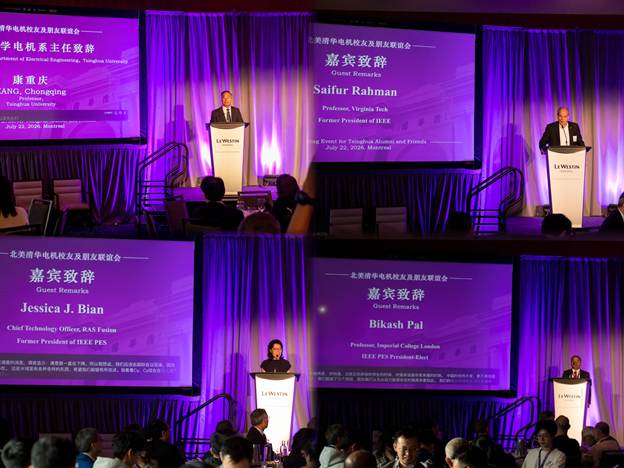
"Kang Chongqing, Saifur Rahman, Jessica J. Bian, and Bikash Pal Deliver Addresses"
During the interactive session, attendees first took ten minutes to introduce their research areas and affiliated institutions within their tables, after which each table nominated a representative to give a two-minute presentation to the entire audience introducing the members at their table. These brief yet engaging introductions quickly bridged distances among participants and laid the groundwork for subsequent in-depth exchanges and collaborative opportunities.
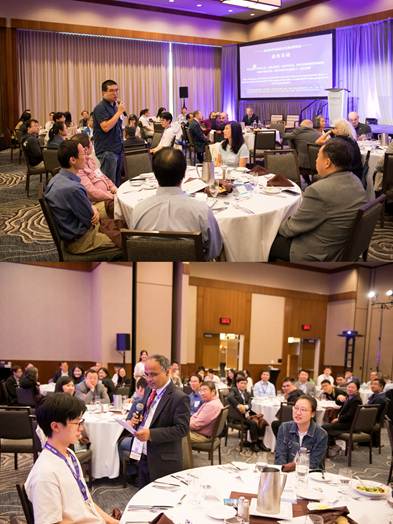
Lively and spirited table discussions and representative introductions
In the keynote speech session, Professor Anjan Bose of Washington State University, Professor Claudio Cañizares of the University of Waterloo, Professor Vladimir Terzija of Newcastle University, and Professor Pierluigi Mancarella of the University of Melbourne successively shared their observations on education, research, and career development in energy and power in the AI era.
Professor Anjan Bose pointed out that AI is driving profound changes in engineering education, graduate training, and research methodologies. Looking ahead, he emphasized that talent development must place greater emphasis on real-world problems, problem-definition skills, and engineering practice, while re-examining the current publication-centric tendencies in training and reflecting on the long-term impact of AI on power system research paradigms and engineering positions.
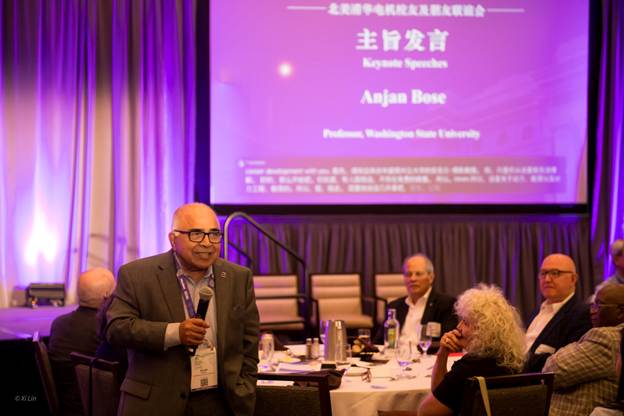
Professor Anjan Bose delivering a keynote speech
Professor Claudio Cañizares, focusing on AI applications in power systems, stressed that insufficient high-quality data, scarcity of extreme-event samples, and imbalanced data distributions pose key challenges to model training and deployment. He proposed that data generation, continuous learning, and monitoring should be integrated with human professional judgment, and that interdisciplinary teams should be relied upon to jointly advance the development of sustainable energy systems.
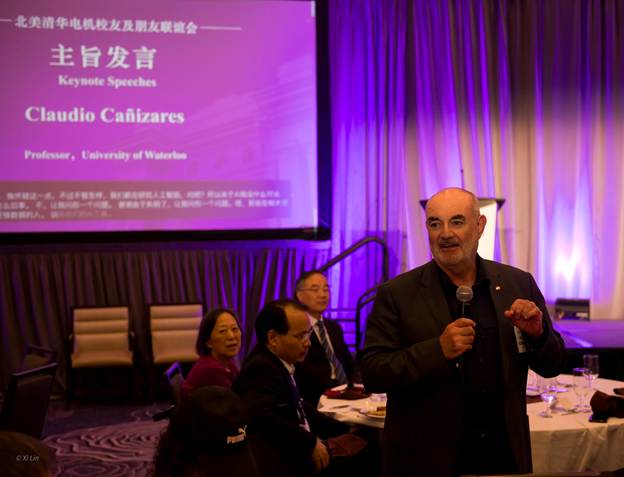
Professor Claudio Cañizares delivering a keynote speech
Professor Vladimir Terzija reviewed the evolution from early expert systems and MATLAB to contemporary AI tools. He noted that AI can accelerate learning and research, yet the comprehension and internalization of knowledge still require time. Education, he argued, should enhance efficiency while maintaining a firm grasp of fundamental principles and specialized expertise.
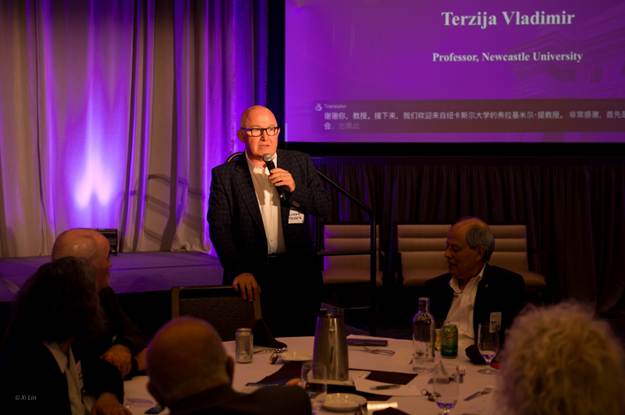
Professor Vladimir Terzija delivering a keynote speech
Professor Pierluigi Mancarella, drawing on his long-standing involvement in international academic exchanges, recalled fond memories of interactions with Tsinghua University and Chinese colleagues. He expressed his hope that international platforms such as IEEE PES would serve as bridges to further deepen exchanges and cooperation across regions and institutions, thereby jointly advancing power and energy education and industry development.
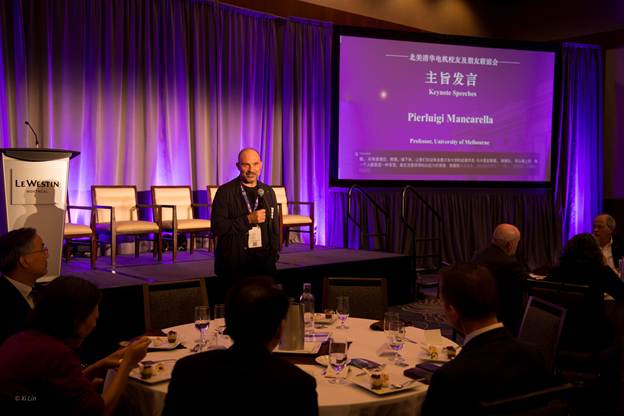
Professor Pierluigi Mancarella delivering a keynote speech
In the dedicated panel discussion session, Professor Nanpeng Yu of the University of California, Riverside served as moderator, joined by panelists Dr. Hong Chen of PJM Interconnection, Professor Lang Tong of Cornell University, Dr. Xi Lin of Powertech Labs, and Dr. Song Zhang of ISO New England. The five guests engaged in a dialogue from the distinct perspectives of academia and industry, focusing on the impact of AI on the competency structures, research methodologies, and career trajectories of power professionals. The panelists observed that the value of AI lies not only in automating repetitive tasks and enhancing efficiency, but also in helping practitioners identify and define the problems truly worth solving. For young students and early-career professionals, they advised solidifying a foundational expertise in power and energy while making adept use of AI tools, cultivating cross-cutting competencies in data engineering and cloud services, understanding the specialized languages of different disciplines, and maintaining independent judgment and a commitment to continuous learning.
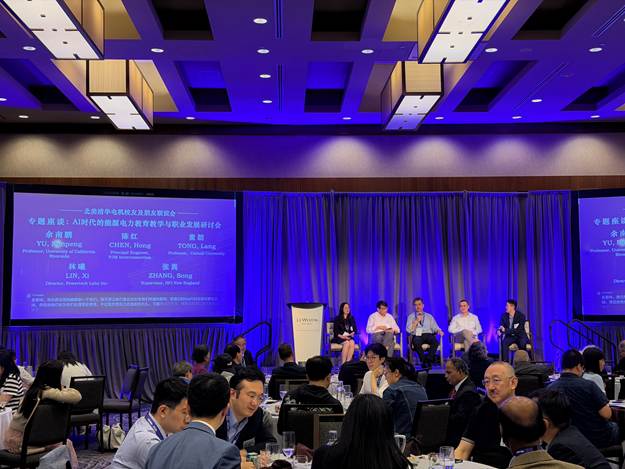
Panel discussion on "Education, Teaching, and Career Development in Energy and Power in the Age of AI"
Following the conclusion of the symposium's formal agenda, the networking and fellowship activities continued. Participants engaged in lively exchanges on research collaboration, career development, and cutting-edge industry topics, lingering long after the scheduled end. They expressed their hope that this gathering would serve as a new starting point for collaborative exploration and mutual growth in the era of deep integration between AI and energy and power, and looked forward to reconvening again next year.


















 News & Events