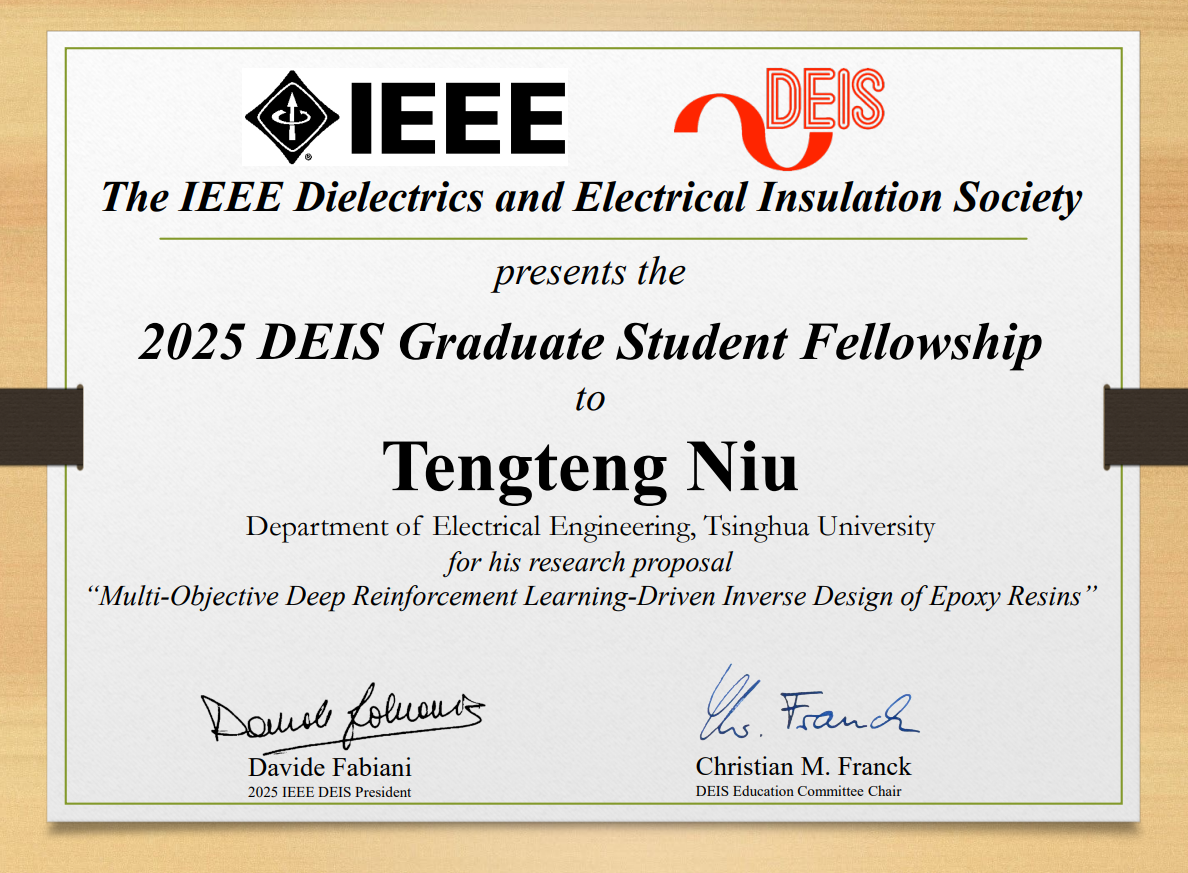
Recently, the Institute of Electrical and Electronics Engineers (IEEE) Dielectrics and Electrical Insulation Society (DEIS) selected six recipients of the 2025 IEEE DEIS Graduate Fellowship worldwide. Each awardee will receive a scholarship of USD 5,000. In 2025, PhD student Niu Tenteng from the Department of Electrical Engineering, Tsinghua University, received this honor.

The IEEE DEIS Graduate Fellowship, established by the IEEE Dielectrics and Electrical Insulation Society, aims to support graduate students worldwide engaged in research related to electrical insulation and dielectric environments. Research topics may include insulation materials, dielectric properties and breakdown, charge transport, high-voltage effects, and other related areas. The evaluation criteria focus primarily on the innovation of the research topic, the impact of the selected research area, and the candidate’s ability to accomplish the proposed objectives during the fellowship period. Awardees are selected through anonymous peer review by members of the DEIS Education Committee.
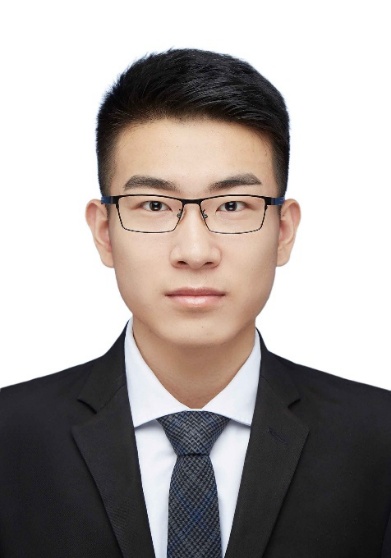
The project awarded to Niu Tenteng is titled “Inverse Design of Epoxy Resin Molecular Structures Based on Multi-objective Deep Reinforcement Learning,” supervised by Associate Professor Yang Ying. This project aims to utilize molecular structure–property prediction models, generative optimization algorithms, and reinforcement learning methods to efficiently explore the vast chemical space and inversely design epoxy resins that simultaneously exhibit excellent thermal resistance, insulation performance, and mechanical strength, achieving quantitative and systematic optimization of molecular structures. This research provides a new technical pathway that breaks through the efficiency bottleneck of the traditional experience-driven “trial-and-error” paradigm and offers theoretical and methodological support for the design and engineering applications of high-performance epoxy resins.


















 News & Events