Recently, the team led by Lin Jin from the Department of Electrical Engineering, in collaboration with Xiamen University and China Energy Hydrogen Technology Co., Ltd., was invited to publish a perspective article entitled “Holistic strategies for scaling water electrolysis” in Nature Chemical Engineering. Focusing on the critical transition of water electrolysis technology from laboratory research to large-scale industrial application, the article systematically examines the challenges facing the scale-up of water electrolysis from interdisciplinary perspectives spanning materials science, electrochemistry, chemical engineering, and energy systems. It proposes a shift away from optimizing individual performance indicators toward system-level coordinated optimization oriented to actual industrial needs.
Article Overview
Against the backdrop of the global energy transition, green hydrogen is becoming an important means of promoting the low-carbon transformation of energy systems and deep decarbonization of industry. In recent years, global planning and investment in green hydrogen projects have continued to grow, and electrolyzer costs have declined rapidly. However, a significant gap remains between the actual operational scale and planned targets. The article points out that the key to scaling up green hydrogen is no longer simply further reducing the equipment costs of electrolyzers, but rather improving the economic performance of projects over their entire life cycle.
Equipment costs, system efficiency, operating hours, operation and maintenance costs, and equipment lifespan all jointly affect the final cost of hydrogen production. Taking actual green hydrogen projects at the 100 MW scale as examples, a 10% improvement in system energy efficiency can reduce the levelized cost of hydrogen by approximately 9%–10%, whereas a 10% reduction in electrolyzer equipment costs lowers the levelized cost of hydrogen by less than 2%. This indicates that future cost reductions in green hydrogen production will require a shift from optimizing individual equipment costs toward the coordinated optimization of multiple factors, including efficiency, service life, operation, and cost.
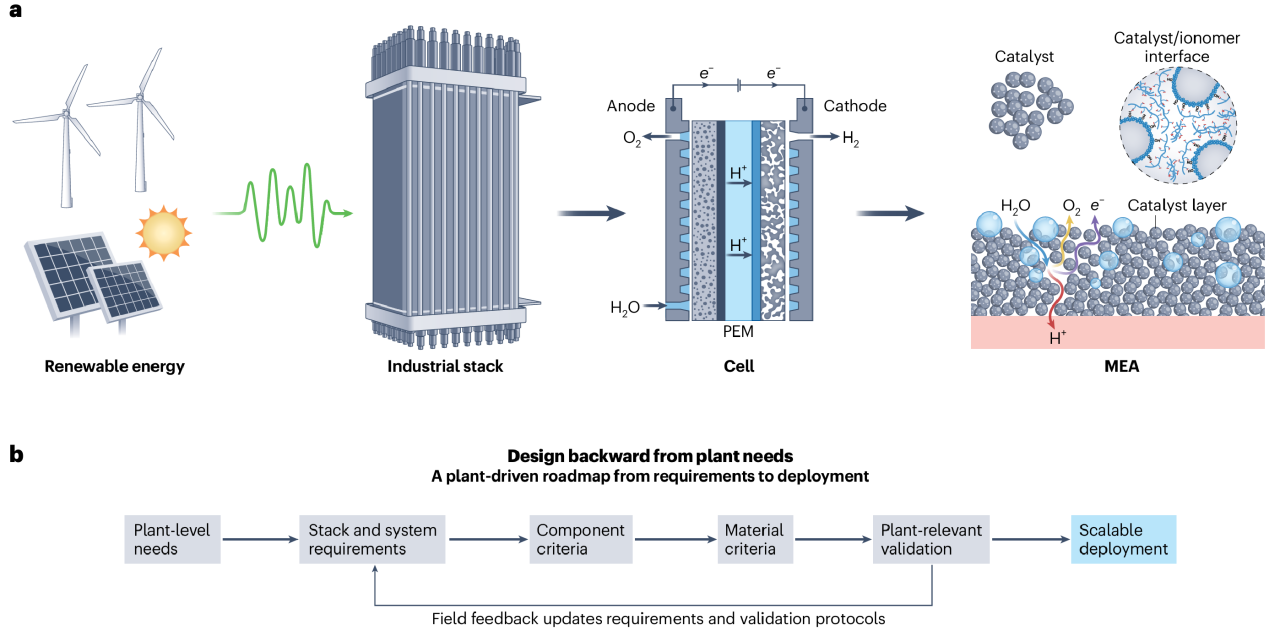
A System-Needs-Oriented Pathway from Industrial Requirements to Materials Design and Large-Scale Deployment
Addressing the difficulty of maintaining the performance of high-performance laboratory technologies during industrial scale-up and adapting them to actual operating conditions, the article further points out that the key constraint on the large-scale application of water electrolysis technology is no longer simply achieving better laboratory performance. More importantly, it is the ability to establish effective links between actual industrial requirements and fundamental materials research. To this end, the research team proposes starting with actual industrial operating requirements and progressively translating engineering constraints—including renewable energy fluctuations, frequent start-ups and shutdowns, pressure variations, and manufacturing consistency—into design requirements for systems, electrolyzers, key components, and materials. By combining testing under conditions close to actual operating environments with operational feedback, a closed-loop R&D framework can be established, shifting water electrolysis technology development from a laboratory-performance-oriented approach to one driven by industrial application needs. This approach embodies cross-scale coordination among materials science, electrochemistry, engineering technologies, and energy systems, while providing a new research paradigm for translating fundamental research achievements into industrial applications.
Looking ahead to the development of green hydrogen technologies, the article also identifies four important directions from the perspective of deep integration between energy and chemical engineering systems: electrification of chemical processes, off-grid hydrogen production, intelligent autonomous operation, and distributed modularization. The article argues that future research on water electrolysis should not be confined to improving the performance of electrolyzer units themselves. Instead, greater emphasis should be placed on coordination among renewable energy generation, hydrogen production, hydrogen storage, and downstream utilization. Interdisciplinary integration across fundamental materials, electrochemical devices, process engineering, and energy systems should also be strengthened to improve the flexibility, reliability, and life-cycle economic performance of green hydrogen systems.
Academician Zheng Nanfeng and Professor Tao Huabing of Xiamen University, Director Liu Wei of the Hydrogen Energy Division of China Energy Group, and Associate Professor Lin Jin of the Department of Electrical Engineering at Tsinghua University are the corresponding authors. Huang Meiquan, a doctoral student at Xiamen University, and Chi Yingtian, a postdoctoral researcher in the Department of Electrical Engineering at Tsinghua University, are the co-first authors. This research was supported by the Ministry of Education's Basic and Interdisciplinary Sciences Breakthrough Program (JYB2025XDXM306).
Paper Link: https://doi.org/10.1038/s44286-026-00451-7


















 News & Events