On September 16, the appointment ceremony for a Tsinghua University Distinguished Visiting Professor and an academic lecture were held in Room 103, Zone 3, West Main Building. Professor Campbell Booth, Vice Principal of the University of Strathclyde, UK, was invited to visit, was appointed as a Tsinghua University Distinguished Visiting Professor, and delivered an invited academic lecture on the future operation, protection, and monitoring of decarbonized power and energy systems. Professor Hong Qiteng from the Department of Electronic and Electrical Engineering at the University of Strathclyde, Kang Chongqing, Dean of the Department of Electrical Engineering, Professor Wang Xiongfei of the Department of Electrical Engineering, Research Professor Wang Bin of the Department of Electrical Engineering, and other experts and scholars from China and the UK as well as more than 40 faculty and student representatives participated in the event. The lecture was chaired by Sun Kai, Deputy Dean of the Department of Electrical Engineering.
At the appointment ceremony, Sun Kai introduced Professor Campbell Booth's academic achievements and his important contributions to promoting Sino-British academic exchanges and talent cultivation. Kang Chongqing presented Professor Booth with the Tsinghua University Distinguished Visiting Professor appointment certificate, and the two sides exchanged university souvenirs.
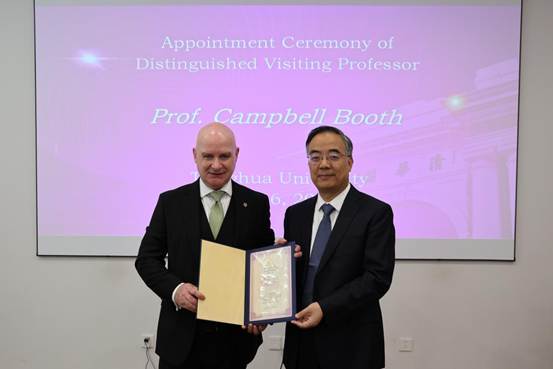
Kang Chongqing presenting Professor Booth with the Tsinghua University Distinguished Visiting Professor appointment certificate
Professor Booth delivered remarks on his appointment, stating that being appointed a Tsinghua University Distinguished Visiting Professor is a great honor in his career with profound significance. He particularly thanked Tsinghua University for its long-standing support, friendship, and trust, and said he would cherish this honor, actively fulfill the duties of a Distinguished Visiting Professor, and contribute to exchanges and cooperation between the two sides.
He affectionately reviewed the long history of educational exchanges between China and the UK, and, drawing on his own experience, introduced the solid foundation that the University of Strathclyde and Tsinghua University have formed over many years in research cooperation, faculty-student exchanges, international summer schools, and achievement transformation. He stated that universities in China and the UK face many common challenges in the energy and power fields and should further strengthen mutual learning and cooperation. Professor Booth also introduced that the University of Strathclyde values research innovation and achievement transformation, relies on engineering experimental platforms and industry-academia-research cooperation to drive research results to serve practical needs, and regards talent cultivation and the development of young scholars as important support for innovation. He spoke highly of China's achievements in fields such as high-speed rail and renewable energy, and said he is willing to take this appointment as an opportunity to actively fulfill his duties, promote the two universities' continued deepening of cooperation in research, talent cultivation, and academic exchanges, and sincerely welcome Tsinghua faculty and students to visit the University of Strathclyde for exchanges.
In his keynote lecture, Professor Booth focused on the future operation, protection, and monitoring of decarbonized power and energy systems and analyzed the new challenges brought by the high-proportion integration of renewable energy and the large-scale connection of power electronic equipment. He pointed out that as power systems traditionally dominated by synchronous machines transform into more complex, active, and highly power-electronics-based systems, system inertia, fault characteristics, and frequency and voltage stability all change, imposing new requirements on traditional protection, monitoring, and control technologies.
Addressing the above issues, Professor Booth introduced his team's research in areas such as grid-forming control, synchronous condensers, traveling wave protection, wide-area monitoring, hardware-in-the-loop simulation, digital twins, and early warning of anomalous events, and shared explorations such as using abandoned coal mines for energy storage and digital planning of multi-vector energy systems, demonstrating a multidisciplinary research path oriented toward future energy systems.
Professor Booth also focused on the new impacts on power systems brought by the rapid development of artificial intelligence and large data centers. As AI computing demand grows, large-scale data centers may generate gigawatt-level electricity demand, imposing new requirements on grid planning, power supply, and system flexibility; at the same time, the adjustable loads of data centers may also become an important flexibility resource for future power systems. He stated that artificial intelligence is profoundly changing teaching, research, and the way knowledge is produced, while also bringing new challenges. In key areas such as power system protection, the advantages and limitations of AI should be fully recognized to ensure the reliability and safety of technology application.
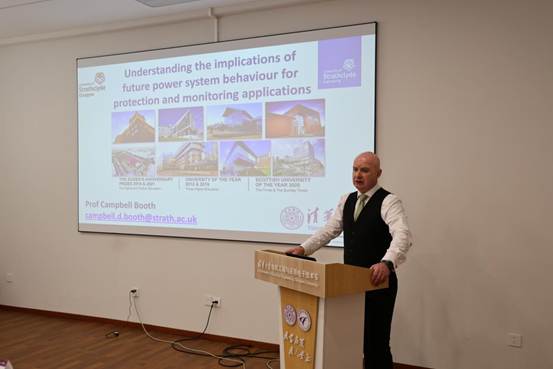
Professor Booth delivering a Jingde Forum academic lecture
After the lecture, participating faculty and students held in-depth discussions on issues such as AI-enabled power systems, multi-energy coupling modeling, and wide-time-scale simulation. Professor Booth introduced that, faced with differences in time scales and professional models among different energy systems such as electricity, heat, and hydrogen, his team uses multi-platform co-simulation and data interfaces to achieve cross-domain interaction, so as to better support research on the planning and operation of future multi-vector energy systems.
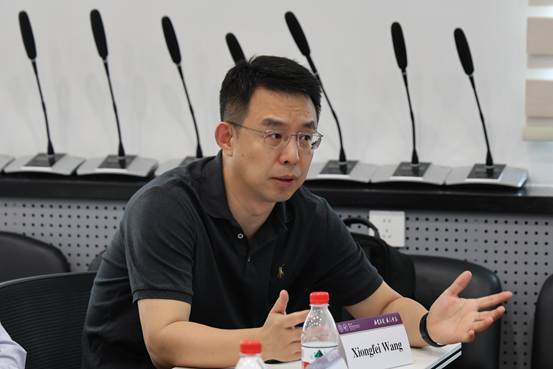
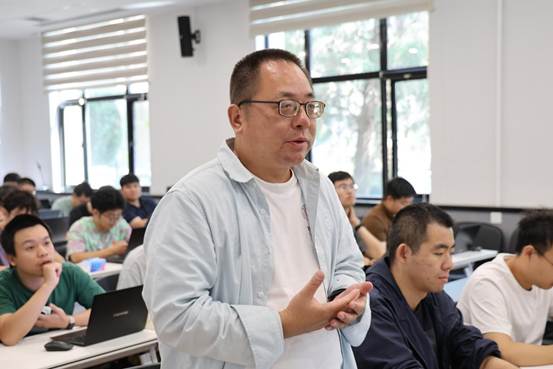
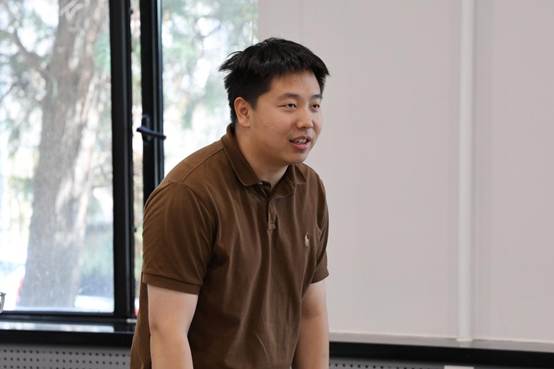
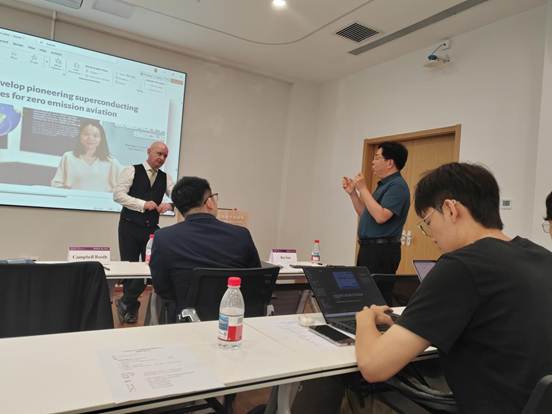
Q&A Session
This appointment and invited lecture further consolidated the long-term stable cooperative relationship between Tsinghua University and the University of Strathclyde. Both sides stated that they will continue to deepen research cooperation and faculty-student exchanges in fields such as new-type power systems, energy transition, and talent cultivation, promote complementary advantages and mutual learning between Chinese and UK universities, and jointly address the new opportunities and challenges brought by the global energy transition.
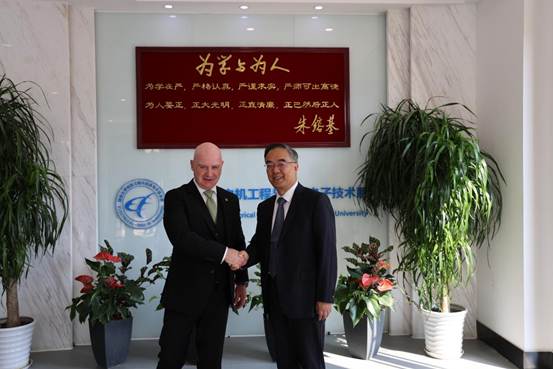
Deepening Sino-British Exchanges, Jointly Promoting Cooperation in the Energy Field
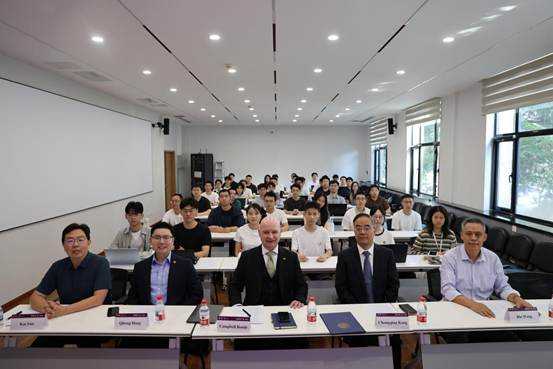
Group Photo of Participants
[About the Guest]
Professor Campbell Booth is currently Vice Principal of the University of Strathclyde and also serves as Executive Dean of the University's Faculty of Engineering. The Faculty comprises 8 departments and multiple innovation centers, with more than 1,000 faculty and staff and more than 6,000 students, making it one of the largest engineering faculties in the UK.
Professor Booth's connection with the University of Strathclyde spans 40 years; he entered the university in 1987 to study electronic and electrical engineering as an undergraduate and later obtained his doctorate. His research focuses on power system protection and monitoring. Currently, he serves as the Principal Investigator of ENSIGN, a major "Prosperity Partnership" project of the UK Engineering and Physical Sciences Research Council (EPSRC), with partners including SP Energy Networks, the University of St Andrews, the University of Liverpool, Heriot-Watt University, and multiple other institutions.
He has led key projects such as EFCC and Phoenix, and also co-led, with Professor Dong Xinzhou of the Department of Electrical Engineering at Tsinghua University, a completed Sino-British collaborative research project jointly funded by EPSRC and the National Natural Science Foundation of China. Professor Booth has published numerous high-level academic papers and holds multiple invention patents, and is also a co-founder of Synaptec, a University of Strathclyde spin-out company; this company focuses on distributed sensing and monitoring technology and obtained financing in 2024 to support business development. He has been invited to give invited lectures on many occasions, served as Chair of the IET International Conference on Developments in Power System Protection (DPSP), and is active in multiple industry working groups.


















 News & Events