Recently, the Yi Chenyi team from the Department of Electrical Engineering, in collaboration with Xiamen University and Jinan University, achieved an important breakthrough in the field of perovskite solar cells. The related research results, entitled "Prussian blue regulates ion dynamics in perovskite solar cells," were published in the international academic journal Science.
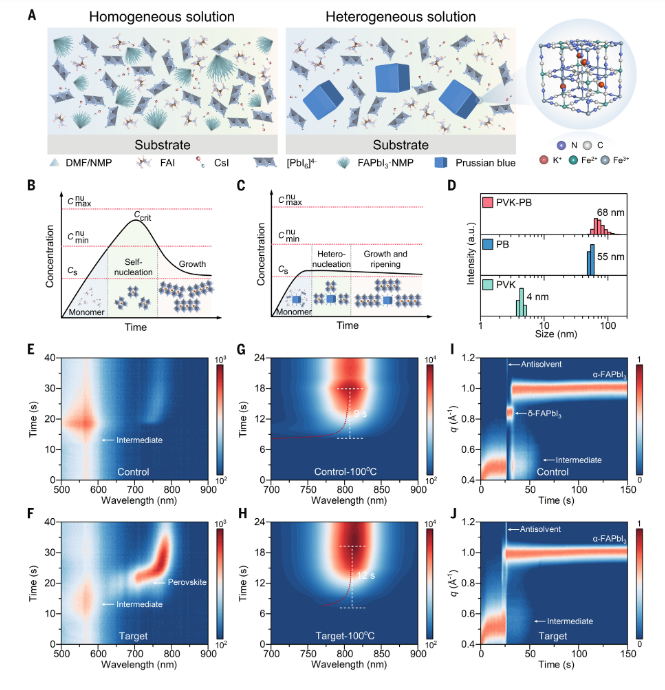
Fig. 1: Thermodynamics and kinetics of Prussian blue template-regulated perovskite crystallization
In recent years, perovskite solar cells have rapidly approached mature silicon technology in photoelectric conversion efficiency, but the transition from small-area laboratory devices to commercial modules still faces a persistent challenge: the perovskite lattice is in a state of dynamic evolution—random nucleation and intermediate-phase evolution during solution processing introduce residual strain, lattice disorder, and elemental defects, and these defects "seeded" during the crystallization stage are amplified under subsequent light, heat, and electrical bias, driving ion redistribution and irreversible degradation.
To address the above challenge, the research team innovatively introduced a rigid, structurally cognate Prussian blue (PB) framework. Prussian blue is lattice-matched to halide perovskites, and its robust Fe-C≡N-Fe network enables PB both to induce ordered crystallization of the film and to maintain structural integrity during device operation. Specifically, during the crystallization stage, PB promotes heterogeneous nucleation and suppresses intermediate phases, producing highly oriented, strain-relaxed perovskite films; during the operation stage, its redox activity can mediate the conversion of Pb⁰ and I⁰ defects, and its rigid open-framework structure can also suppress the redistribution of A-site cations and electron inhomogeneity under bias.
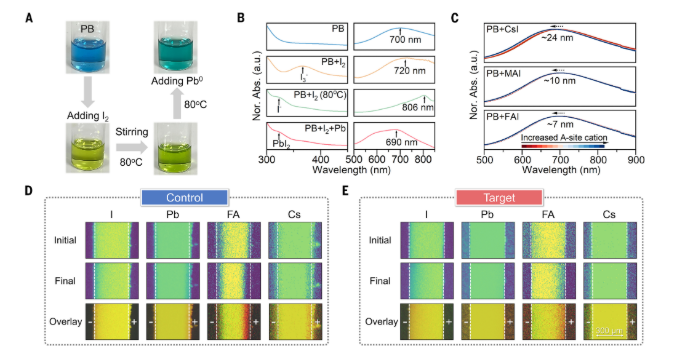
Fig. 2: Mechanistic exploration of regulating perovskite ion dynamics using Prussian blue
The results show that after introducing PB nanoparticles as a functionalized template, the performance of perovskite cells with both the regular (n-i-p) and inverted (p-i-n) structures can be improved, and high-efficiency perovskite modules can be realized based on this method. For example, the introduction of PB can increase the champion photoelectric conversion efficiency (PCE) of n-i-p devices from 24.2% to 26.1%; the champion PCE of p-i-n devices reaches 26.9% (certified efficiency 26.2%), compared with 26.0% for control devices. The research team further extended this strategy to perovskite solar modules. A 6 cm×6 cm mini-module achieved a champion PCE of 23.4%, a substantial improvement over the 20.1% of the control group. Further scaling up to a 30 cm×30 cm module (aperture area 756 cm⟡) achieved a certified PCE of 22.9% and a steady-state output efficiency of 22.8%.
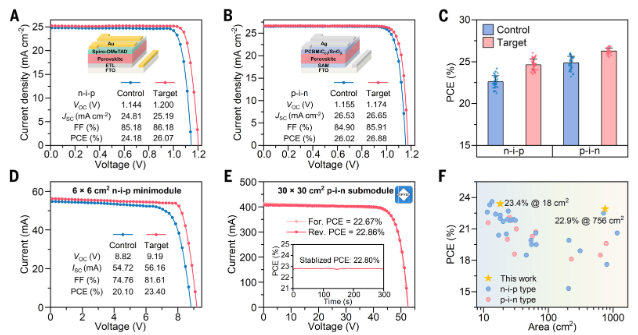
Fig. 3: Photovoltaic performance from small-area cells to large-area modules
In terms of stability, the mini-module maintained more than 90% of its initial efficiency after 2500 hours of aging at 85°C, 85% relative humidity, and more than 80% after 2200 hours of continuous maximum power point tracking (MPPT) at 65°C and 50% relative humidity. Further studies showed that under conditions of 68 -110°C sun illumination, and MPPT, the degradation of the modules follows an Arrhenius relationship, with an apparent activation energy of about 0.74 eV; the extrapolated T80 at 35°C operation is about 6.2×10⁴ hours (about 7 years). In addition, the study also conducted outdoor testing; in a 5-month ISOS-O-2 test in Zhuhai, the normalized efficiency ratio of the perovskite modules prepared by this method relative to a commercial silicon module reference was close to 1, with no obvious degradation, demonstrating their good outdoor stability.
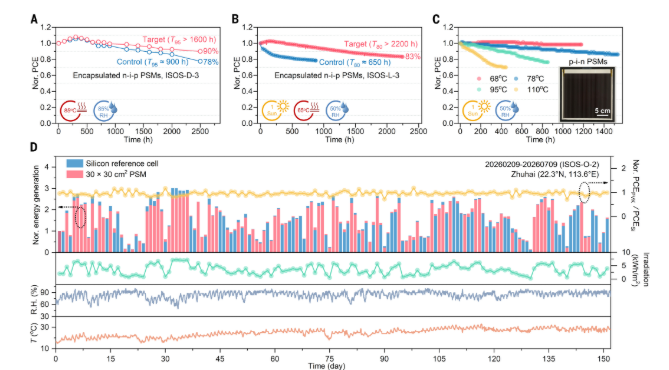
Fig. 4: Device stability evaluation under various stress conditions
Yi Chenyi from the Department of Electrical Engineering and "Shuimu Scholar" postdoctoral fellow Zhou Junjie are respectively the co-corresponding author and co-first author of this paper; the corresponding authors of the paper also include Zheng Nanfeng and Wu Binghui of Xiamen University, and Mai Yaohua and Liu Chong of Jinan University. This research was supported by the National Natural Science Foundation of China and the Special Fund for Basic Research of the Independent Innovation Research Program of the Department of Electrical Engineering, Tsinghua University.
Paper link: https://www.science.org/doi/10.1126/science.aef5487


















 News & Events