From April 23 to April 27, ICLR 2026 was successfully held in Rio de Janeiro, Brazil. A paper from the team led by Professor Kang Chongqing and Associate Professor Zhang Ning of the Department of Electrical Engineering was accepted by ICLR 2026, marking the first ICLR publication in the history of the department.
Conference Overview
The International Conference on Learning Representations (ICLR) is a globally recognized top-tier conference in deep learning. Founded in 2013 by two leading figures in deep learning—Turing Award laureates Yoshua Bengio and Yann LeCun—it is widely regarded as one of the “three major conferences” in machine learning, alongside NeurIPS and ICML, with strong international influence. ICLR ranks 8th in Google Scholar’s conference/journal rankings, with an H5-index of 362, placing it alongside top journals such as Science, Nature, and Cell in the global top tier. ICLR 2026 received nearly 19,000 valid submissions, with an acceptance rate of approximately 28%.
Paper Overview
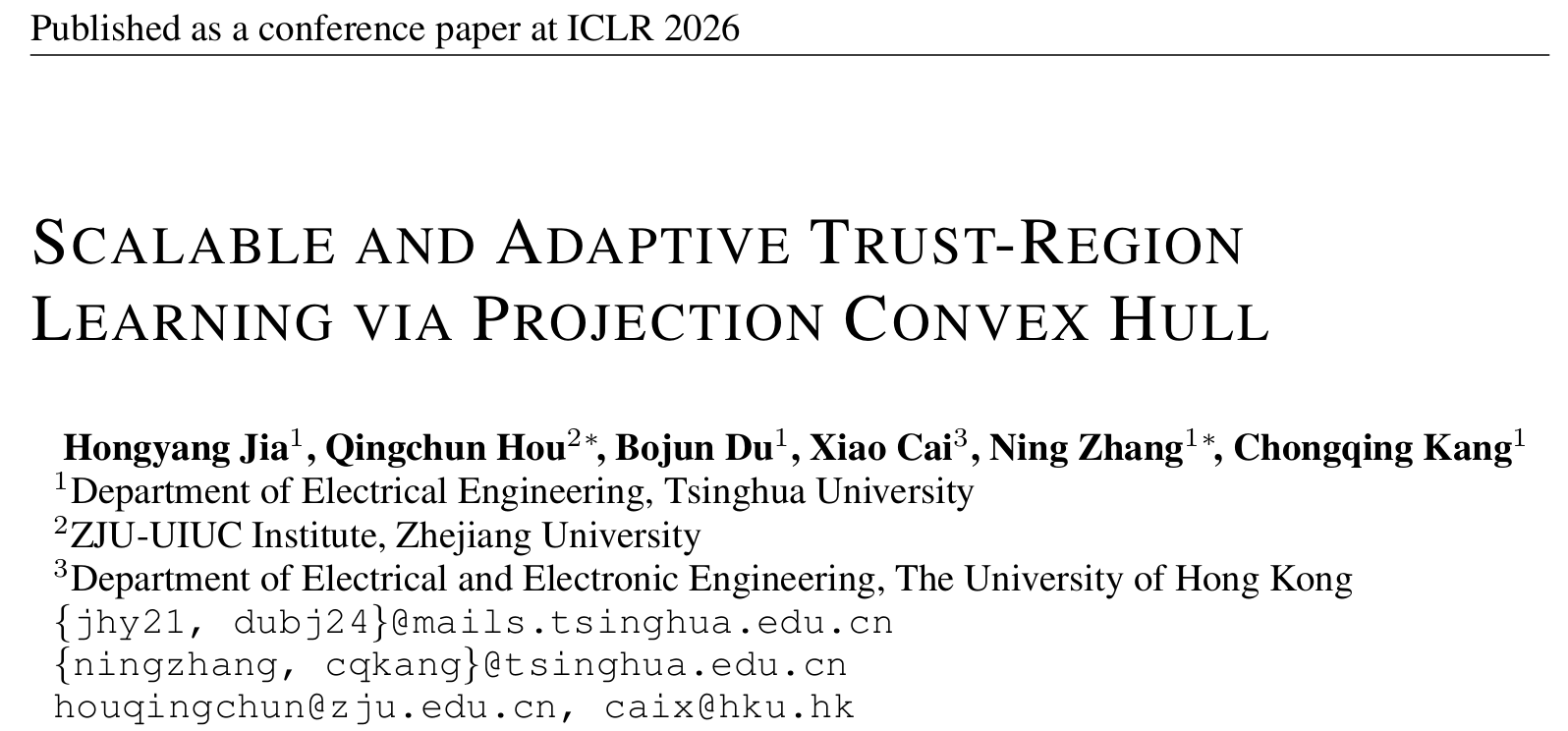
The paper, titled “Scalable and Adaptive Trust-Region Learning via Projection Convex Hull,” was authored by PhD student Jia Hongyang (first author), Associate Professor Zhang Ning and Researcher Hou Qingchun (corresponding authors), along with Professor Kang Chongqing, PhD student Du Bojun, and Postdoctoral Fellow Cai Xiao from the University of Hong Kong.
With large-scale renewable energy integration and increasingly complex power system operation modes, security and stability analysis and optimization decision-making in power grids are facing higher dimensionality, stronger uncertainty, and stricter real-time constraints. In tasks such as power system operation optimization, planning, and security-constrained learning, researchers typically extract stability boundaries from large volumes of historical or simulation data and embed them into dispatch, control, and planning models. How to extract security and stability rules from massive datasets and effectively apply them to operational optimization and planning has become an important research direction at the intersection of artificial intelligence and power systems.
However, when data-driven constraints are embedded into optimization models, optimal solutions often drift toward under-sampled regions, leading to reduced reliability near critical boundaries. For safety-critical systems such as power grids, it is not sufficient to optimize only average performance; it is crucial to clearly define the regions in which constraints are truly “trustworthy” and can reliably guide optimization. Based on this understanding, the team further focused on the problem of trustworthy region learning, exploring how to provide reliable operational boundaries for data-driven safety constraints.
In tasks such as classification prediction, constraint learning, and decision optimization, convex hulls are often used to characterize data boundaries or serve as trustworthy regions, defining the reliable operating range of predictive models or optimal decisions. However, in scenarios with high-dimensional and massive samples, learning a convex hull that is both tight and trustworthy from data, thereby improving the reliability of optimization-based decisions, remains a significant challenge. On the one hand, traditional convex hull learning methods suffer from sharply increased computational complexity in high-dimensional spaces, and it is difficult to control the structure of the convex hull. On the other hand, existing constraint learning methods often focus on fitting the distribution of training samples, neglecting the embedded effect of the constraint learning model near the optimal solution of the optimization decision. When these constraints or convex hulls are embedded into an optimization model, the optimal solution is often pushed toward regions with sparse or even no training data coverage, causing the boundary to lose validity near the optimal solution. Therefore, how to learn a convex hull structure that truly plays a role in optimization decisions and maintains trustworthiness in critical regions is an urgent problem to be solved in constraint learning and trustworthy optimization-based decision-making.
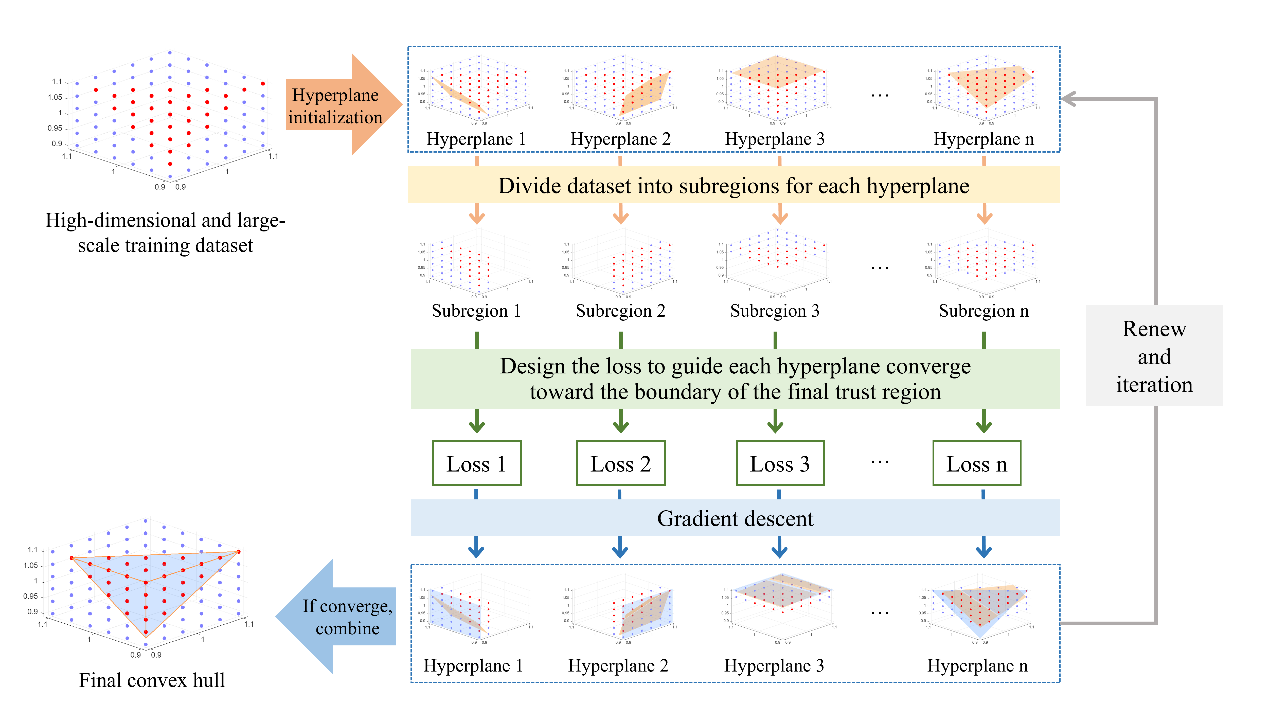
Convex Trust Region Learning and PCH Framework
To address these challenges, the team proposed the Projection Convex Hull (PCH) method, providing a unified theoretical and algorithmic framework for learning convex trust regions. Starting from a mixed-integer nonlinear programming formulation of the tightest convex hull, the team derived an unconstrained optimization objective suitable for gradient descent and proved its equivalence to the original formulation under appropriate weighting conditions. Based on this, PCH constructs supporting hyperplanes adaptively and in parallel through sub-region partitioning, weight assignment, and gradient updates, producing a compact polyhedral convex hull that tightly encloses positive samples while excluding negative samples. The resulting convex hull can be explicitly embedded as a trust region into subsequent constrained learning and embedded optimization processes, thereby restricting decisions within data-supported regions. Extensive experiments demonstrate that PCH significantly outperforms traditional geometric and optimization-based methods in terms of accuracy, scalability, and compactness, particularly in high-dimensional and large-scale settings. The learned trust region can be directly applied to power system security rule extraction and embedded into optimization constraints, improving both safety and computational efficiency. In addition, the trust region can serve as a high-quality training foundation for other AI models, reducing model complexity and enabling parameter compression.
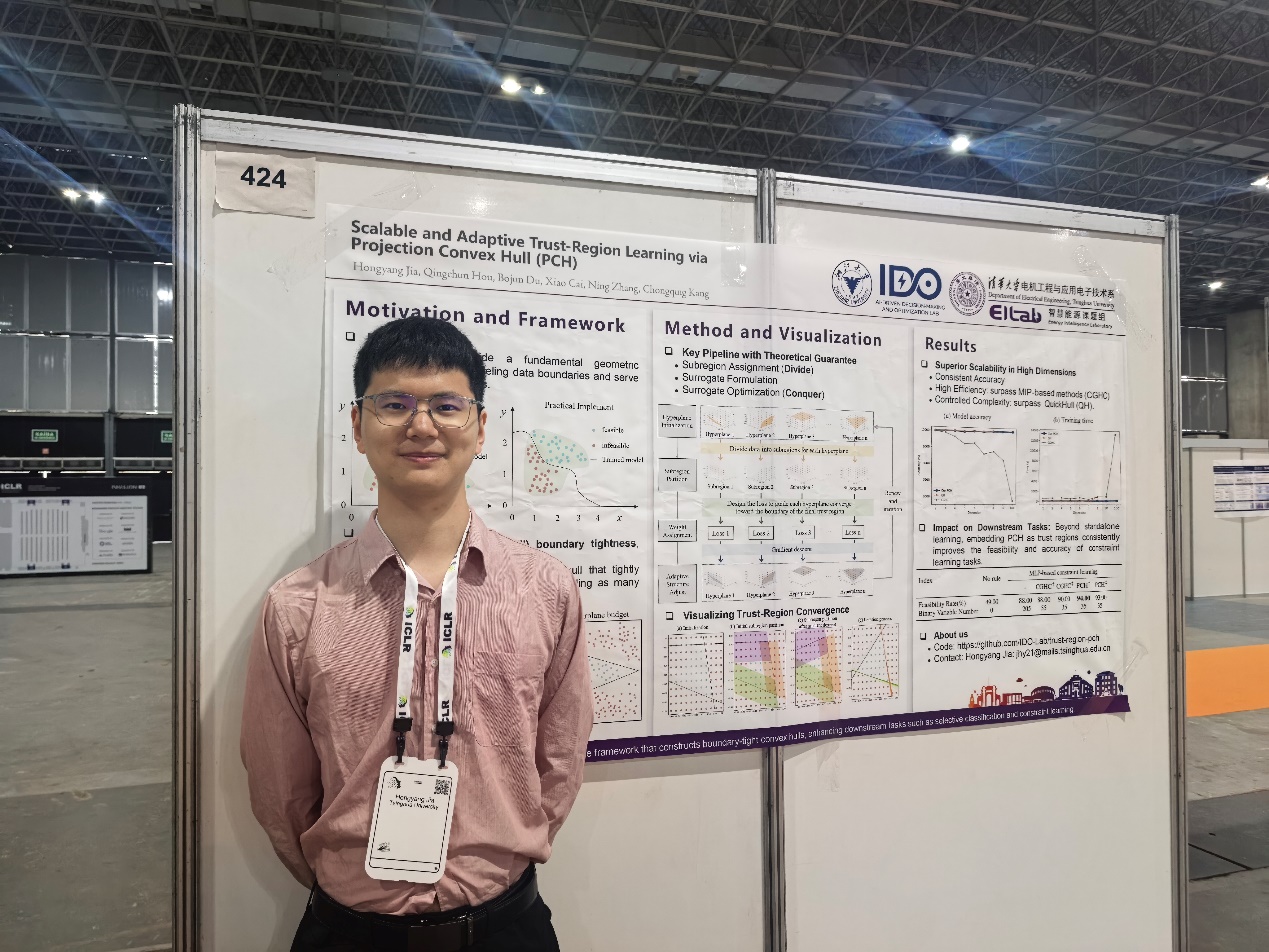
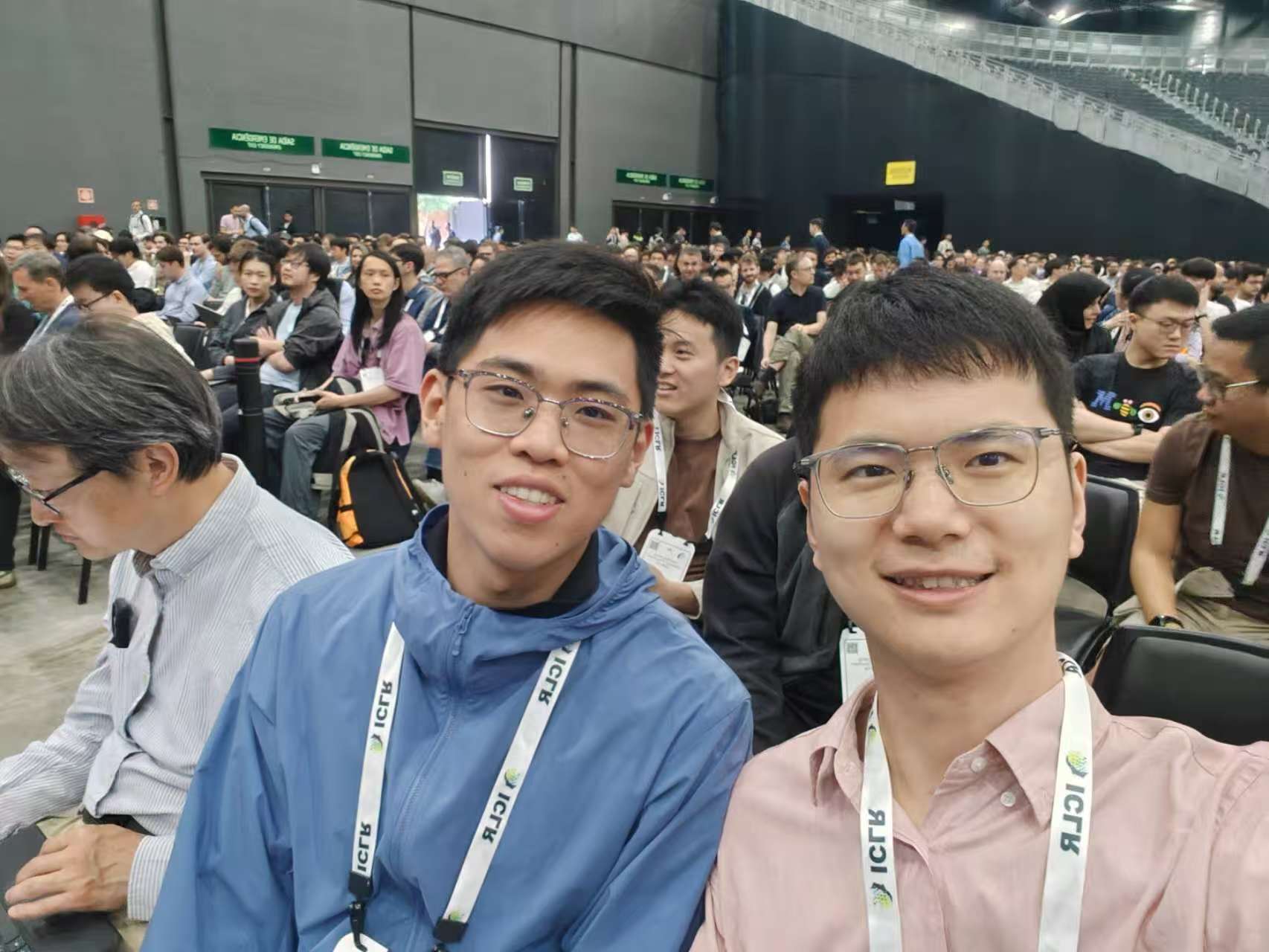
PhD students Jia Hongyang and Du Bojun from the Department of Electrical Engineering, Tsinghua University, attended ICLR 2026 in Brazil
Paper code: https://github.com/IDO-Lab/trust-region-pch
Paper link: https://openreview.net/forum?id=Kjcs0xJxdg
Extended Reading
Professor Kang Chongqing and Associate Professor Zhang Ning’s team continues to advance interdisciplinary research in AI and power systems. Their recent perspective article published in China Electrical Engineering Journal has received over 1,600 CNKI downloads and more than 9,000 WeChat article views within three months. They were also invited to publish in the IEEE flagship journal Proceedings of the IEEE, presenting research on security-constrained rule learning and embedding in power system planning and operation “Data-driven Security and Stability Rule in High Renewable Penetrated Power System Operation”.


















 News & Events