Against the backdrop of the accelerating transition of the energy system toward clean and low-carbon development, how to build a new-type power system with new energy as the mainstay has become a strategic issue related to energy security, industrial upgrading, and technological self-reliance. On October 25, 2025, China Southern Power Grid (CSG) and the Department of Electrical Engineering and Applied Electronics (EEA) of Tsinghua University jointly held in Guangzhou the New-Type Power System Exchange Seminar and the 15th Engineering Doctoral Forum of EEA, together with the 9th Graduate Supervisor Training and Exchange. Attendees included Li Licheng, Honorary Director of the Expert Committee of CSG and Academician of the Chinese Academy of Engineering; Li Jianshe, Chief Engineer of CSG; and Kang Chongqing, Dean of EEA. Focusing on technological innovation and engineering practice of the new-type power system, the forum conducted in-depth discussions around frontier directions such as system cognition, regulation and control systems, flexible grid-forming, energy storage, and digital power grids. Meanwhile, the forum was divided into two parallel sessions featuring topic proposal reports by engineering doctoral students and training and exchange for graduate supervisors, with discussions centered on enhancing the teaching and supervision capabilities of young doctoral supervisors as well as the high-quality cultivation and graduation of engineering doctoral students in EEA. A total of more than 100 participants attended the forum, including 47 innovative leading engineering doctoral students from EEA of Tsinghua University, as well as numerous experts and scholars from China Southern Power Grid, State Grid Corporation of China, the Chinese Academy of Engineering, Huairou National Laboratory, and senior professors from EEA. The forum was chaired by Gao Wensheng, Responsible Professor for Engineering Doctoral Programs of EEA.
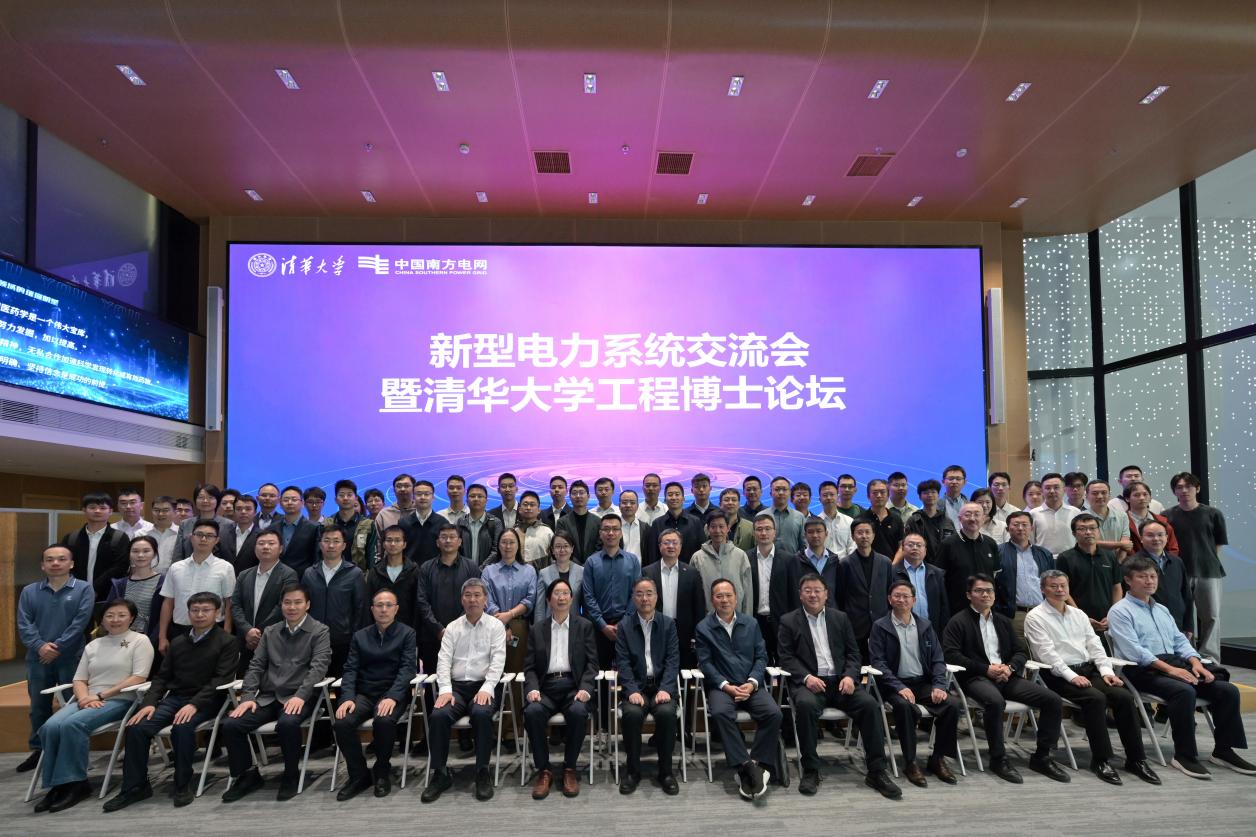
The opening ceremony of the forum was held on the morning of October 25. Li Licheng delivered an opening address, noting that as China’s energy structure continues to evolve toward a high proportion of new energy, the operating mechanisms, network configurations, and safety and stability control boundaries of power systems are undergoing profound restructuring. He emphasized that the essence of the new-type power system lies in achieving a diversified, flexible, and coordinated dynamic balance within an energy system “with electricity as the hub,” representing a systematic reshaping spanning technological systems, operational systems, and governance systems. China Southern Power Grid has achieved world-leading strengths in multi-terminal flexible DC transmission and power grid regulation and control systems, providing deterministic engineering capabilities to support the long-distance transmission of tens of millions of kilowatts from large-scale new energy bases. Looking ahead, he stressed that the development of the new-type power system should adhere to a systems perspective in understanding system-level problems, and advance synergistically in areas such as digital infrastructure construction, wide-area stability control, and the integration of energy, information, and computing power, to build a digitally empowered resilient power grid.
In his address, Kang Chongqing stated that the recently convened Fourth Plenary Session of the 20th CPC Central Committee has made clearer strategic positioning of the energy and power sector in its deployment for achieving high-level scientific and technological self-reliance and building a science and technology powerhouse by 2035. As a key hub in China’s low-carbon transition of the energy structure, the new-type power system serves as an important engine for promoting the green upgrading of the industrial system and the evolution of digital and intelligent infrastructure. China Southern Power Grid has been at the forefront nationwide in engineering innovation practices related to the new-type power system, providing real, open, and verifiable innovation scenarios for Tsinghua University’s scientific research exploration and talent cultivation. He expressed sincere gratitude to colleagues from China Southern Power Grid for their strong support and dedicated efforts in organizing the forum, which has built a valuable platform for scientific research and talent development. Looking ahead to national strategic needs, he emphasized the establishment of sustained, systematic, and evolvable joint innovation models, under which all parties will carry out deeper collaboration in key core technologies, system-theoretical innovation, and engineering-oriented research organization models.
Subsequent forum presentations closely revolved around core issues in the reshaping of power systems. Academician Li Licheng delivered a keynote speech titled “Scientifically Defining the ‘New’ in the New-Type Power System—Some of My Thoughts,” starting from the origins, connotations, and logical system of the “new,” and proposing a scientific definition framework for the new-type power system centered on the core characteristics of “explainability, verifiability, and controllability,” emphasizing that research must return to physical mechanisms and system laws themselves. Liu Yingshang, former Deputy Chief Engineer and Director of System Operations of China Southern Power Grid, focused on the evolution of dispatching capabilities in the new-type power system, systematically analyzing stability risks under multi-source grid-connection conditions, changes in the composition of regulation capabilities, and operational trade-off methods, and proposing the development of stronger, more intelligent, and efficient system operation and dispatching technical support to meet the needs of new-type power system development. Zheng Waisheng, Chairman of the China Southern Power Grid Research Institute, in his presentation “Stability Mechanisms and Evolutionary Laws of the New-Type Power System,” further addressed key issues such as how stability mechanisms evolve, whether stability problems can be solved, and how to solve them, starting from typical converter control structures and grid-connection characteristics. Through theoretical analysis, numerical simulation, and engineering verification, he proposed engineering practice pathways for stability-enhancing measures and strengthened the adaptive capability of power systems. In the area of energy storage and system coordination, Zheng Yaodong, former member of the Expert Committee of China Southern Power Grid, delivered a presentation titled “Viewing New Energy Storage from Multiple Perspectives,” systematically elaborating on the trend of energy storage value cognition shifting from a single functional supplement to a participant in system operational structures, and proposing the establishment of sustainable value return mechanisms for energy storage. Li Peng, Deputy General Manager of the Strategic Planning Department of China Southern Power Grid, presented “Engineering Practices and Development Prospects of Flexible Grid-Forming in China Southern Power Grid,” sharing the overall layout in CSG’s “15th Five-Year Plan” for the evolution of flexible grid structures and the enhancement of power system resilience. He noted that flexible grid-forming can effectively avoid cascading failures and excessively wide impact ranges in large AC power grids, while maintaining flexible inter-regional mutual support capabilities. Professors Hu Wei and Ci Song from EEA of Tsinghua University approached the topic from perspectives of intelligent cluster dispatching and energy-information analytics, respectively, proposing that energy storage systems should be deeply integrated with regulation and control, markets, and digital twin systems to achieve a transition from device-level optimization to system-level optimal performance.

This forum served not only as a platform for the exchange of frontier ideas and innovative achievements, but also as an important vehicle for deepening university–enterprise cooperation and jointly cultivating high-end talent. On the afternoon of the same day, proposal defenses for six engineering doctoral students and exchange discussions among graduate supervisors were also conducted.
During the engineering doctoral proposal session, evaluation experts from Tsinghua University and China Southern Power Grid carried out systematic assessments and professional guidance on the research progress and engineering practice achievements of engineering doctoral students, further strengthening the collaborative talent cultivation model of deep integration among industry, academia, research, and application through a two-way interactive mechanism.


During the graduate supervisor exchange and discussion session, supervisors focused on key issues such as optimizing the advisor–student relationship, improving daily management mechanisms, enhancing the effectiveness of teacher–student communication, and controlling critical stages in the training system for engineering doctoral students, particularly issues related to the management of full-time engineering doctoral students during enterprise-based professional practice. Throughout the discussions, participating supervisors actively offered suggestions and recommendations, drawing on their own experiences and reflections to provide constructive solutions to address pain points and challenges in talent cultivation.

On the morning of October 26, representatives of some experts and scholars visited the State Key Laboratory of DC Transmission Technology and the National Innovation Center for New Energy Storage. At the State Key Laboratory of DC Transmission Technology, they conducted on-site inspections of the ultra-high-voltage flexible DC transmission R&D platform, gaining in-depth understanding of the latest breakthroughs achieved by China Southern Power Grid in the field of DC transmission. Subsequently, at the National Innovation Center for New Energy Storage, they observed on-site demonstrations of various energy storage experimental platforms and pilot systems, personally experiencing the engineering applications of new energy storage technologies.

This forum represented not only an in-depth academic exchange, but also, against the backdrop of the energy revolution and high-level scientific and technological self-reliance, a profound exchange and mutual learning between leading engineering forces in the industry and high-level scientific research and innovation teams. It vividly reflected the practical achievements and sense of responsibility demonstrated by China Southern Power Grid, Tsinghua University, and other participating institutions in serving the national “dual carbon” strategy and promoting energy transition.
All parties will continue to strengthen joint research efforts and collaborative talent cultivation, persistently explore approaches to refining scientific questions driven by engineering scenarios, advancing the restructuring of technological systems through systems thinking, and promoting the practical application, industrialization, and standardization of research outcomes through open cooperation, jointly contributing to the construction of a safe, clean, low-carbon, efficient, resilient, and intelligent new-type power system.


















 News & Events